Navigating the UAE’s corporate landscape demands strict following of regulatory standards. Whether you plan on structuring cross-border investments, setting up a new corporate bank account, or getting into major joint ventures, proving the legal legitimacy of your entity is non-negotiable.
A Certificate of Good Standing in Dubai caters as an important tool in such high-level scenarios. As regulatory scrutiny across the United Arab Emirates and foreign jurisdictions tightens in 2026, precisely understanding how to get, utilize, and maintain this vital certification is a crucial component of solid corporate governance.
Understanding What is a Certificate of Good Standing

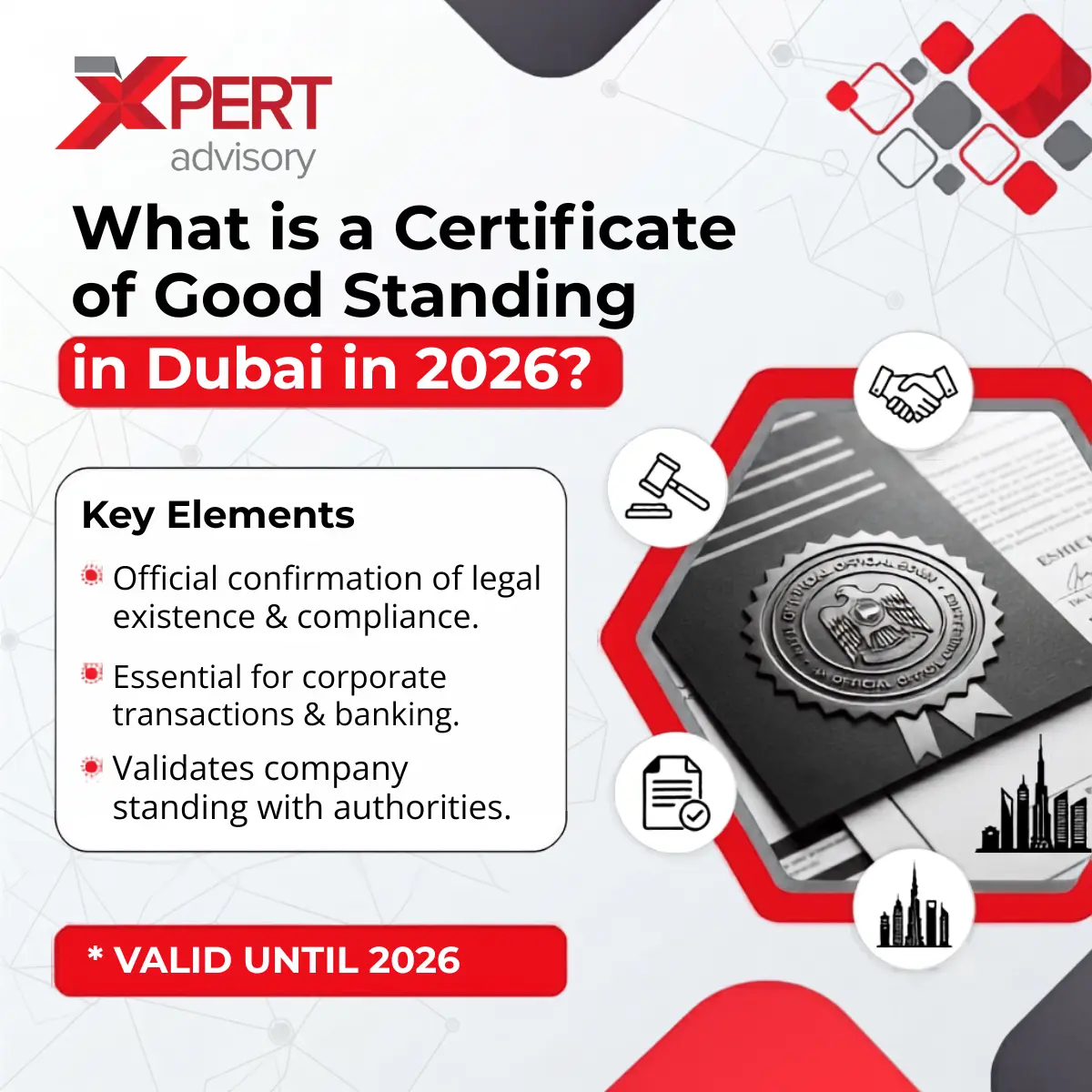
A Certificate of Good Standing refers to an official document issued by the government that a business entity or professional is actively licensed, operating legally, and 100% compliant with every local regulatory obligation at the issuance time.
It serves as a compliance snapshot. It authenticates that the trade license of the entity is active, the needed government filings remain maintained, and there are zero unresolved administrative fines, penalties, or holds that are attached with the company record.
What the Certificate Does Not Confirm
In order to avoid critical delays during the process of corporate transactions, it is equally vital to understand the major limitations of this document.
- The Certificate does not give historical data or provide assurance of future compliance.
- It does not confirm Value Added Tax or VAT Compliance or cater as an official tax clearance certificate.
- It does not provide AML (Anti-Money Laundering) or sanctions clearance.
- It does not confirm that fiscal audits have been completed.
Strategic Instances: Where is the Certificate Needed?
Giving an active & compliant corporate status’ proof is no more an administrative afterthought. It is a very strict prerequisite for major business maneuvers. One typically needs this important document in case of the following scenarios:
- Corporate Banking: Needed by fiscal institutions during the initial process of bank opening, periodic KYC (Know Your Customer) reviews, or when you are updating authorized signatories.
- Corporate Restructuring: Vital when undertaking transfer of shares, internal reorganizations, or combining entities. (For complicated transitions, premier Corporate Restructuring services ensure that every entity remains compliant before as well as during the shift).
- Internal Expansion: Needed by overseas authorities and fiscal institutions to authenticate the legal existence of a UAE firm before permitting cross-border transactions or branch setups.
- Visas & Immigration: Often requested when applying for UAE partner visas, investor visas, or when setting up a framework for Visa & Residency Services for global teams.
- Wealth Management: A foundational document when establishing holding firms, trusts, or implementing a Family Office Setup.
Pre-Application Eligibility Checklist
Licensing bodies will instantly reject an application if a firm’s file is not precisely aligned with the ongoing regulations. BEfore starting a request, ensure that the following criteria are met properly:
- The official trade license needs to be fully valid and active.
- Every outstanding government fine, penalty, and renewal charge must get settled.
- Precise UBO (Ultimate Beneficial Ownership) records must get declared and updated.
- Details of company registration, including authorized signatories as well as contact information, needs to precisely match the authority’s database.
Engaging leading Governance & Compliance Advisory before application is seriously recommended to identify and resolve all forms of administrative gaps.
How to Apply: Issuing Authorities and Processes
Dubai does not leverage a single centralized system for this specific document. The issuing authority as well as the specific application process depends completely on where the entity gets registered.
1. Mainland Firms (DET)
For business entities functioning on the Mainland of Dubai, the DET or the Department of Economy and Tourism is the official issuing authority.
- Procedure: Applications that get submitted online through the Invest in Dubai portal with the help of the UAE Pass credentials.
- Terminology: The DET usually issues this certificate as a “To Whom It May Concern” letter or a “Status Certificate” as opposed to using the “Good Standing” term.
2. Free Zone Entities
Free Zone firms function under independent regulatory frameworks, i.e., certificates must get certificates must get requested directly from the respective FZA or Free Zone Authority (for instance, DMCC, DIFC, JAFZA, etc.).
- Process: Requests get handled through certain member portals, like AXS for the Dubai Development Authority or the Member Portal of DMCC.
- Terminology: Depending on the respective zone, it may get labelled as a Certificate of Good Standing, Status Certificate, or Certificate of Incumbency.
3. Offshore & Branch Companies
Branch of international companies or offshore entities (like JAFZA Offshore or RAK ICC) face a very distinguished procedure.
- Process: Local offshore registers have the power to issue a local status certificate. However, the authorities of Dubai frequently need a Certificate of Good Standing from the parent firm’s home jurisdiction.
- Requirement: Foreign candidates are required to undergo full legalization prior to legal acceptance.
4. Licensed Professionals
Individuals practicing professionals that are regulated, such as lawyers, doctors, accountants, etc., are required to apply through their particular governing bodies.
- Healthcare: Doctors and nurses are required to apply using the DHA (Dubai Health Advisory) Sheryan system or the MOHAP (Ministry of Health and Prevention).
- Other Specialists: Legal consultants can apply via the Dubai Legal Affairs Department or the Ministry of Economy.
Expenses, Timelines, and Validity
Understanding the fiscal and temporal expectations guarantees smoother planning of transactions.
| Jurisdiction Type | Estimated Government Fees (in AED) | Processing Time |
| Mainland (DET) | 500* – 1,000* | 1-3 working days. |
| Free Zones | 1,000* – 3,000+* | Instant to 2 working days. |
| Professionals | 300* – 500* | 1-3 working days. |
How long does the certificate remain valid? Speaking legally, there is no printed date of expiry. However, in terms of practicality, fiscal institutions as well as international authorities need the certificate to be exceedingly fresh. The Certificate of Good Standing gets rarely affected if is older than 90 days. Numerous institutions prefer documents that are issued within the past 30 days.
International Usage & Attestation

If you intend to leverage a Dubai-issued Certificate of Good Standing for the purposes of overseas banking, market expansion, or international litigation, the digital document only is not sufficient.
It needs a rigid chain of legal attestation. This process generally includes notarization, authentication by the UAE’s MOFA (Ministry of Foreign Affairs), and the final legalization at the destination country’s embassy. Navigating this particular chain can be complicated, thus making professional Document Drafting & Attestation services invaluable for the prevention of international rejections.
Avoiding Common Application Pitfalls
This procedure is highly efficient when correctly executed, but critical mistakes can trigger serious delays. Avoid the following common errors:
- Do not apply while a license renewal is being processed actively.
- Do not apply for the certificate during a pending alteration in shareholders, management, or business activities.
- Avoid submitting a digital screenshot; Ensure always providing the original digitally-signed PDF file which contains the verification code.
Secure Your Corporate Standing by Partnering With Xpert Advisory
Securing a Certificate of Good Standing in Dubai is a relatively straightforward process when your corporate file is perfect. However, treading through the nuances of numerous distinct jurisdictions, resolving sudden blocks of compliance, and managing complicated attestation chains demand precision.
Whether you are going through Company Formation, implementing a high-level merger, or setting up for a foreign banking review, Xpert Advisory ensures that your document is seamless. Our professional Business Advisory team handles the entire regulatory lifecycle on your behalf, permitting you to focus on expanding your enterprise.
All set to streamline your corporate compliance? Get in touch with Xpert Advisory today in order to secure your documentation with unflinching confidence!
Frequently Asked Questions (FAQs)
Q. Is a Certificate of Good Standing compulsory for every business in Dubai?
A. A Certificate of Good Standing is not inherently mandatory for everyday operations, but it is routinely needed by banks, auditors, as well as government bodies for certain actions like setting up corporate bank accounts, renewing facilities, or implementing corporate restructuring.
Q. Can I get the certificate if my firm has outstanding fines?
A. No. Firms having unresolved administrative expenses, outdated trade licenses, or pending compliance charges, are not eligible for the certificate until every issue is fully resolved from the records of the authorities.
Q. What is the main difference between a Certificate of Good Standing and an Incumbency Certificate?
A. A certificate of Good Standing authenticates that the company itself is active legally as well as compliant. An Incumbency Certificate is a separate document that explicitly lists the authorized individuals, like directors, shareholders, legal signatories, who can act on behalf of the company.