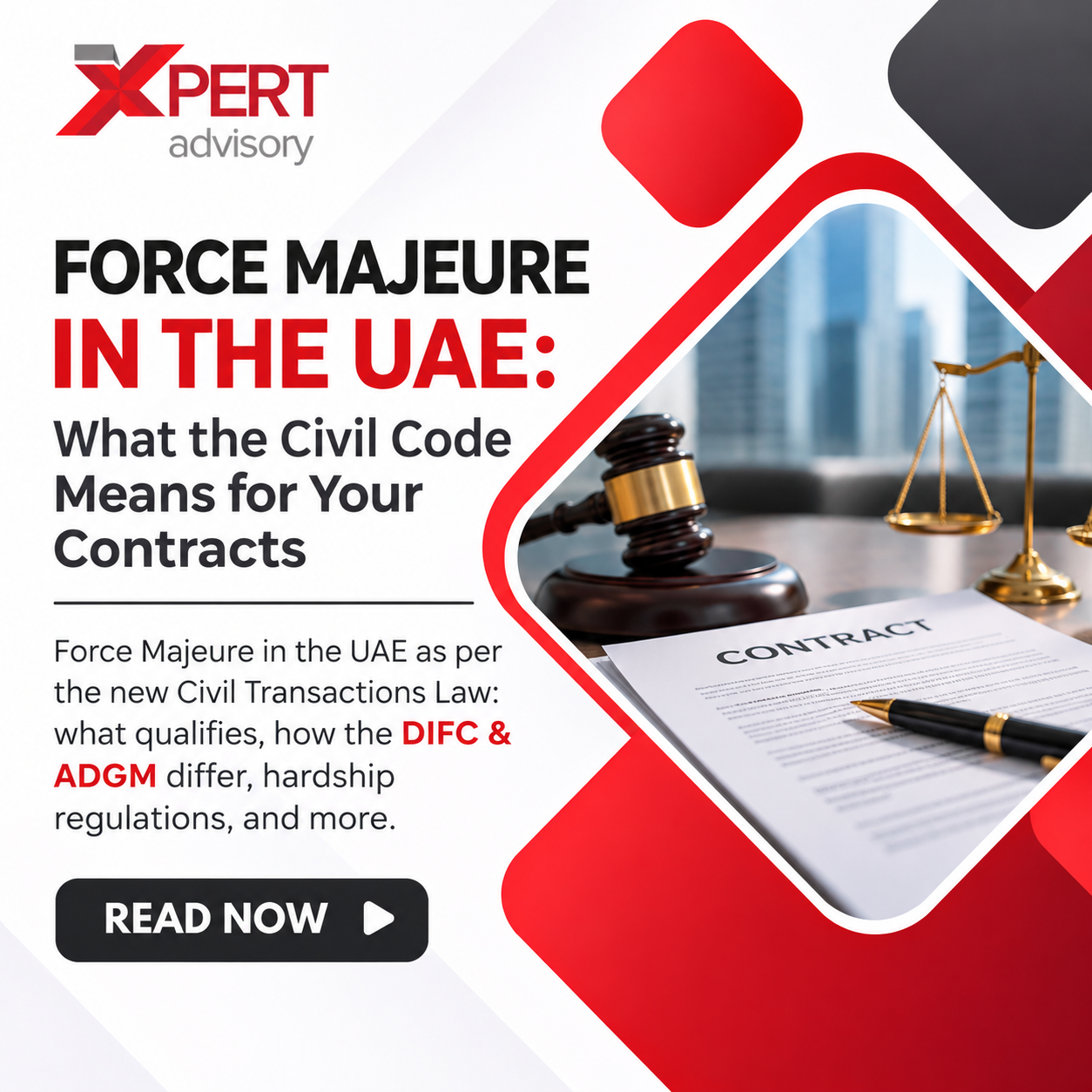
Force majeure in the United Arab Emirates excuses a specific party in the case of an unforeseeable, unavoidable event makes the performance part impossible. Under the brand new Civil Transformation Law, which came into force from the 1st of June, 2026, Article No. 236 ends a contract on complete impossibility in addition to covering partial as well as temporary impossibility. Higher expenses alone are not qualifiable; that is hardship.
The regulations differ again for contracts as per DIFC or ADGM law. Here is what owners of businesses need to check prior to depending on a clause.
What is Counted as Force Majeure Under the Law of the UAE?

A valid claim requires 3 elements: the event was unforeseeable during the signing of the contract, it was unavoidable, and it made performance impossible.
Dubai courts apply this in a very strict manner and require proof that the event was the cause behind the failure. Recent rulings from the Court of Cassation showcase the pattern:
- Judgement 174 of 2023: a claim of COVID-19 failed because the developer was not able to provide the pandemic led to its delay.
- Judgement 1 of 2024: The Russia-Ukraine war got accepted as force majeure, because an expert found out it was the main cause behind shipping delays.
- Judgement 480 of 2024: The claim failed in part, mainly because the contractors’ own actions also led to the delays.
The New Civil Transactions Law – What Changed?
Federal Decree-Law Number 25 of 2025 replaced the old 1985 Civil Code on the 1st of June, 2026. The main test survives, but the remedies are much broader (Mayer Brown, May 2026).
| Issue | Old Law (to 31st May, 2026) | New Law (from 1st June, 2026) |
| Force majeure article | Article No. 273 | Article No. 236 |
| Total Impossibility | Contract ends automatically | Same |
| Partial or Temporary Impossibility | The impossible part ends | That part completes, the contract can get modified, or a court can rescind it |
| Hardship Article | Article 249: court might reduce the burden | Article 224: court might reduce it or end the contract |
In the case of hardship, unforeseeability now gets judged at the contracting time. Contracts that are signed prior to 1st June, 2026 usually stay under the old law (ABS Partners), so ensure checking every contract’s date initially.
Are Hardship and Force Majeure Same?
No. Force majeure requires impossibility. Hardship encompasses exceptional, general events that make performance much more onerous but still possible, like a market-wide shock for inputting costs.
As per Article 224, a court can re-balance the contract by lessening the overall burden to a more reasonable layer, or by completely ending it. Any clause that excludes this specific power is deemed null & void, and thus, a hardship waiver in your contract will not safeguard you.
How Does Force Majeure Work in the DIFC & ADGM?
| Jurisdiction | Legal Basis | If the Contract Does Not Have Clause |
| UAE Mainland | Civil Transactions Law, Article No. 236 | Statutory relief is still applicable |
| DIFC | Contract Law, Article No. 82 | Relief is implied through law |
| ADGM | English Common Law | No force majeure; only narrow frustration |
2 DIFC points catch business entities out. Article No. 82 never excuses a mere obligation to pay. Moreover, the affected entity must provide notice within a reasonable time frame or pay damages (DIFC Control Law).
In ADGM, force majeure is fully contractual, and higher cost/difficulty, is not enough (Charles Russell Speechlys).
Evaluating contracts post a disruption? Get in touch with our team for a confidential assessment.
What Takes Place When Only Part of a Contract Becomes Impossible?
Worked Example: A supplies agrees to a total of twelve monthly shipments at a cost of AED 100,000 each. The closure of a government port then makes 3 shipments impossible. As per Article No. 236, those 3 obligations end, and so does the matching payment of the buyer.
| Shipments | AED | |
| Original Contract | 12 | 0 |
| Extinguished | 3 | 300,000 |
| Still Owed | 9 | 900,000 |
Either entity could request the court to rescind the entire contract. If the port remained open but the expenses of freight doubled, that would be a question of hardship, and not force majeure.
Force Majeure in the UAE: What Should Your Contract Clause Say?
- Governing Law & Courts: Mainland, DIFC, as well as ADGM provide different results, so select deliberately.
- Defined Events: List what counts, like war, sanctions, government orders, as well as epidemics, and say whether the cost elevates the count.
- Notice: Establish a deadline, the content needed, and the evidence expected.
- Payment: Highlight whether the payment obligations are suspended, and for how long.
- Termination: Set when either entity can exit if the event in question lasts extra long.
- Records: Keep evidence linking the event to the failure, primarily because the courts reject unproven claims.
Our seasoned legal document drafting team can establish these terms into contracts, right from a Memorandum of Understanding to supply agreements.
Review your liability insurance at the exact same time, and track force majeure exposure in your framework of risk and compliance.
Need Your Contracts Reviewed?
Whether force majeure or hardship is applicable depends on the wording of your contract, its governing law, and date on which it was signed. Xpert Advisory aids business entities across the United Arab Emirates review pre-existing agreements along with drafting clear risk terms in the case of new ones. Schedule a consultation to discuss all your contracts.
Frequently Asked Questions (FAQs)
Q. What qualifies as force majeure in the UAE?
A. An event officially qualifies as force majeure in the United Arab Emirates when it was unforeseeable at signing, could not get avoided, and made performance impossible. Courts also expect proof that the event was the reason behind the failure. Elevated costs or more difficult performance alone do not qualify.
Q. How did the new Civil Transactions Law alter force majeure?
A. Federal Decree-Law Number 25 of 2025 came into effect on the 1st of June, 2026. As per Article 236, the total impossibility still ends the contract. For partial/temporary responsibility, that portion ends, the contract can get modified, or a court can rescind it. Contracts signed prior to that period usually remain under the old law.
Q. Does force majeure apply in the DIFC if a contract does not have a clause?
A. Yes. Article No. 82 of the DIFC Control Law excuses non-governance caused due to an impediment beyond the control of a party it could not reasonably foresee or avoid. It never implements a mere obligation to pay, and late notice makes the party liable for damages.