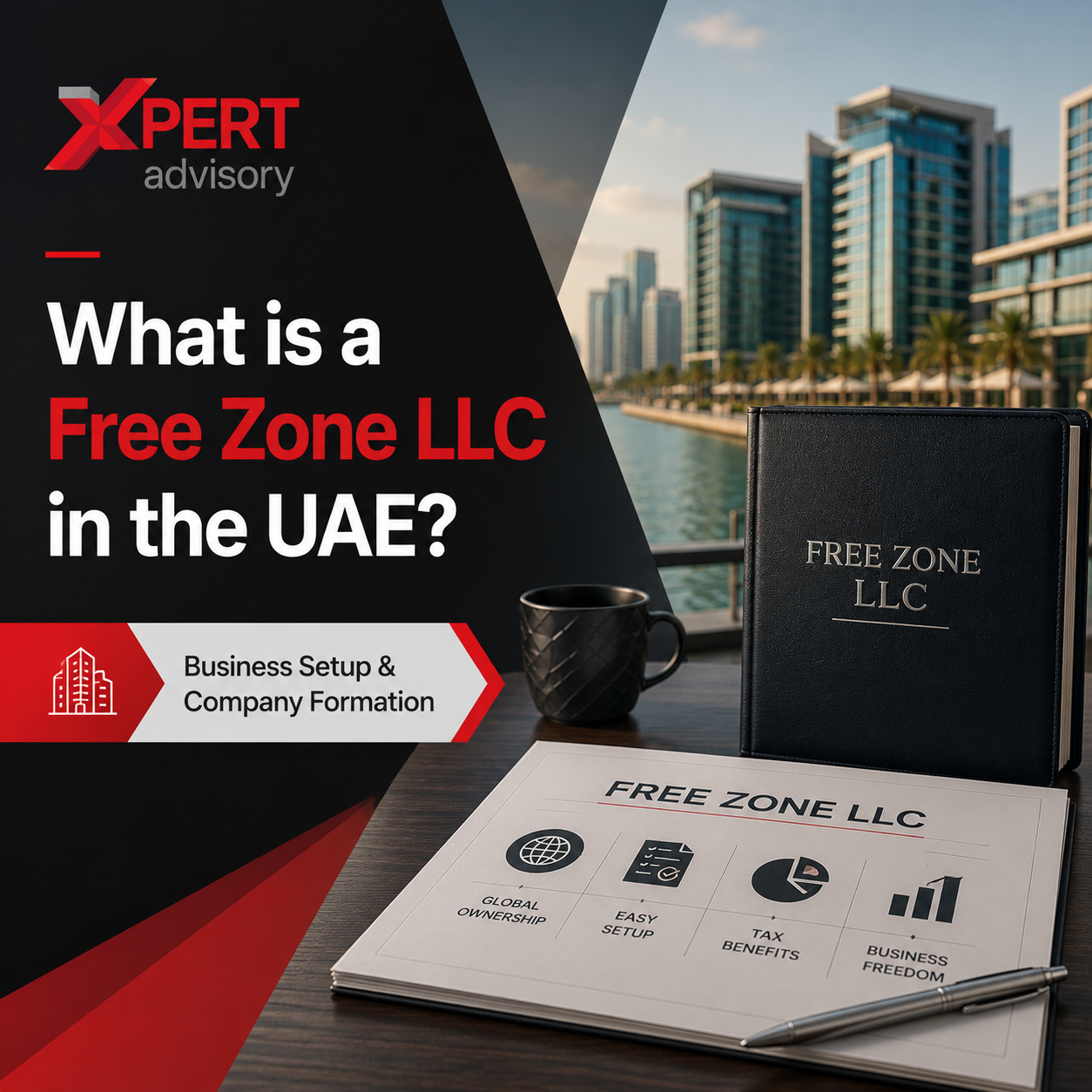
For UNHWIs (Ultra-High-Net-Worth Individuals), HNWIs (High-Net-Worth Individuals), as well as major MNCs, the UAE represents a leading tactical hub for worldwide expansion, wealth management, as well as tax optimization. At the very centre of the UAE’s captivating corporate ecosystem is the FZ-LLC or Free Zone Limited Liability Company.
But what precisely is a Free Zone LLC in the UAE, and more importantly, why is it the most preferred vehicle when it comes to sophisticated international investors? Our definitive guide breaks down the business structure, regulatory frameworks, tactical benefits, as well as the compliance requirements of setting up an FZ-LLC in the United Arab Emirates.
Understanding the Free Zone Limited Liability Company (FZ-LLC) Business Structure
A Free Zone Limited Liability Company, which is also referred to by many as an FZCO, is an independent business entity that is formed within one of the United Arab Emirates’ designated special economic zones (or Free Zones). As opposed to traditional companies situated on the UAE Mainland, an FZ-LLC is directly governed by the independent regulations of the particular FZA (Free Zone Authority) in which it is registered, as opposed to the federal commercial company regulations that govern entities on the mainland.
An FZ-LLC provides a structure of limited liability, meaning the shareholders’ personal assets are strictly restricted, and their liability is directly capped at their share capital investment’s extent.
FZ-LLC vs. FZE: The Main Difference
Within the Free Zones of the United Arab Emirates, you will generally encounter two main company structures:
- FZE or Free Zone Establishment: A single-shareholder entity (may be a single person or a corporate entity).
- Free Zone Limited Liability Company (FZ-LLC / FZCO): A business entity with multiple shareholders (generally allowing between 2-50 shareholders, either individuals or corporate entities).
Strategic Benefits of an FZ-LLC
The Free Zone Limited Liability Company business structure is meticulously designed to foster international trade, innovation, as well as seamless cross-border investments. Here is an overview of the most prominent tactical benefits:
- 100% Foreign Ownership
Historically speaking, operating in the Mainland of the UAE needed a local Emirati sponsor who held a majority stake. Although recent reforms have eased this rule for mainland entities, an FZ-LLC assures complete foreign ownership by default, thereby granting foreign investors total control over their business’ operations and distribution o facets without requiring a local partner.
- Strategic Tax Optimization
The United Arab Emirates remains a very favorable tax environment, although it has made modern changes to its framework in order to align with global standards.
- Corporate Tax Exemption (Qualifying Income): The United Arab Emirates introduced a 9% Tax (Federal Corporate Tax) in 2023 on overall profits exceeding the AED 375,000 mark. However, FZ-LLCs can reap benefits from the 0% Corporate Tax on “Qualifying Income” (total income derived from certain transactions with other Free Zone individuals or qualifying activities) subject to meeting the required criterion.
- 0 Personal Tax: A 0% personal income tax gets levied on both shareholders as well as employees.
- Customs Exemptions: Free Zone Limited Liability Companies enjoy 0% duties from both import as well as export duties for goods moving in/out of the designated Free Zone.
- Complete Capital Repatriation
Major global corporations and High-Net-Worth Individuals need liquidity in addition to freedom of capital movement. A Free Zone Limited Liability Company permits total repatriation of both capital as well as profits to the home country of the investor, totally free of any currency restrictions or controls related to foreign exchange.
- State-Of-The-Art Infrastructure & Industry-Specific Ecosystems
Free Zones in the United Arab Emirates are not merely legal jurisdictions; they are ecosystems that are bespoke, purpose-built. Whether a corporation needs advanced manufacturing facilities, ports (deep-water), S-tier fiscal infrastructures, or top-of-the-line technology parks, there is a specialized UAE Free Zone crafted to that very operational requirement.
Prominent UAE Free Zones for Specialized Industries

The United Arab Emirates houses more than 40 distinct Free Zones. Selecting the right jurisdiction is a vital strategic decision as per the corporation’s sector, needed facilities, as well as regulatory requirements.
- Financial Free Zones (DIFC & ADGM): DIFC (Dubai International Financial Centre) and ADGM (Abu Dhabi Global Market) are Tier-1 fiscal hubs. Vital for foreign investors, these Free Zones functions as per their civil & commercial regulations based on the English Common Law, thereby offering unrivaled legal certainty when it comes to holding companies, wealth management, and fintech.
- Commodities & Global Trade (DMCC): The Dubai Multi Commodities Centre, for consecutive years, has been ranked as the globally-leading Free Zone. It is ideal for commodities trading, cryptocurrency, as well as general commerce.
- Logistics & Manufacturing (JAFZA & DAFZA): The Jebel Ali Free Zone & Dubai Authority Free Zone offers direct, unrestricted access to the globe’s largest seaports as well as airports, perfect for heavy industry, logistics, as well as global supply chains.
- Technology & Media (DIC & DMC): Dubai Internet City & Dubai Media City are deemed the regional HQs for global technology and media conglomerates.
- Aviation, Logistics, and E-Commerce (Dubai South): Constructed around the Al Maktoum International Airport, the Dubai South Free Zone is a major aerotropolis that caters a leading, multi-mode hub in the realm of aviation, contract logistics, as well as digital commerce.
Key Regulatory & Compliance Frameworks
Major multinational corporations need strict adherence to the established global compliance standards. Operating a Free Zone Limited Liability Company in the United Arab Emirates necessitates staying fully compliant with modernized regulatory frameworks:
- UBO (Ultimate Beneficial Owner) Regulations: For ensuring complete transparency in addition to combatting finance-related crime, FZ-LLCs are mandated to maintain a precise UBO register and file it with the concerned Free Zone Authority.
- ESR (Economic Substance Regulations): FZ-LLCs that conduct certain “relevant activities” (e.g., banking, insurance, management of investment funds, intellectual property) must prove that they have enough economic substance (physical presence, staff member, and expenses) within the United Arab Emirates.
- Auditing Requirements: Although not universally required for small-scale setups, premium UAE Free Zones, such as the DMCC, DIFC, and ADGM, mandate the official submission of annually-audited fiscal statements by an approved auditor of the UAE.
Also Read: What Is the Difference Between Free Zone and Offshore Company In UAE?
Core Requirements for Setting Up an FZ-LLC

Although the specific requirements might vary as per the chosen FZA (Free Zone Authority), the foundational prerequisites include the following:
- MInimum Amount of Share Capital: Numerous Free Zones have abolished the requirements for minimum amount of capital (e.g., AED 0). However, certain activities or premium Free Zones might need paid-up share capital ranging between AED 50,000* to AED 1,000,000*.
- Physical Presence: An FZ-LLC is required to officially lease a registered address within its respective UAE Free Zone. This can be anything ranging between the highly cost-effective option of “Flexi-Desk” (virtual office) to premium, commercialized real estate/industrial warehousing. The leased space’s size dictates the visa quota of the company.
- Corporate Officers: The company is mandated to appoint at least one Director & a Manager (can be a corporate entity or the same individual). A Company Secretary is another highly recommended option, and compulsory in certain jurisdictions such as the DIFC.
The Mainland Constraint: Trading Within the United Arab Emirates
It is important to keep in mind the primary limitation of a Free Zone Limited Liability Company in UAE: Location Constraints. However, it cannot directly engage in any direct form of commercial trade, be it B2C or B2B, within the local market of the UAE Mainland.
In order to distribute physical goods to the Mainland of the UAE, an FZ-LLC is required to appoint either a local mainland distributor or commercial agent, or set up a dual-license/mainland branch.
Note: This particular restriction is generally applicable on physical goods; professional services can generally be provided to clients on the Mainland, depending on the particular Free Zone.
Why Partner With Xpert Advisory for Your FZ-LLC Formation?
Setting up a corporate entity for UHNWIs as well as multinational corporations needs much more than merely filling out and submitting applications; it demands tactical foresight, in-depth regulatory knowledge, as well as a nuanced understanding of international tax implications.
At Xpert Advisory, we specialize in bespoke corporate structuring & company formation, providing end-to-end assistance and guidance crafted to the complex requirements of elite global investors. Right from choosing the optimal legal jurisdiction and treading through the complicated tax frameworks to securing premier banking facilities and ensuring seamless ESR compliance, our professional advisors make sure your market entry into the UAE is smooth, completely compliant, and tactically sound.
All set to establish your corporate presence in the United Arab Emirates? Get in touch with Xpert Advisory today to have a conversation without corporate structuring specialists!
Frequently Asked Questions (FAQs)
Q. Can an FZ-LLC do business directly on the UAE mainland?
A. A Free Zone Limited Liability Company is not allowed to directly sell physical goods in the mainland market of the UAE. To do so, each company is required to partner up with a licensed mainland distributor or a logistics agent, or get a mainland branch license. However, specific service-based & consulting FZ-LLCs may work with clients on the mainland, depending on the particular Free Zone regulations.
Q. Do FZ-LLCs in UAE pay UAE Corporate Tax?
A. The UAE imposes a 9% CT on total profits more than AED 375,000*. However, Free Zone individuals can benefit from zero Corporate Tax (strictly on “Qualifying Income”). On the other hand, income derived from non-qualifying activities on the Mainland is subject to the standard rate of 9%.
Q. Is a local UAE sponsor needed to establish an FZ-LLC?
A. No. One of the main advantages of an FZ-LLC is that it permits 100% foreign ownership. There is no need for a local UAE sponsor to function as a sponsor or hold any company shares.